Tags: transformation archetypes art
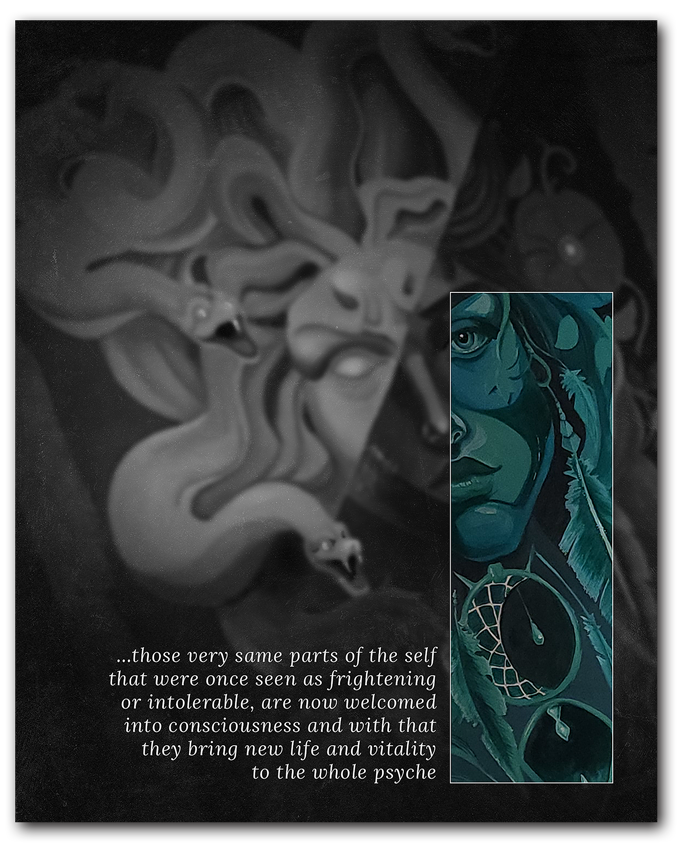
Medusa, 2024. Acrylic. Yours Truly.
The story of Medusa is complex and multifaceted. There are many versions of the story, and many interpretations. The interpretation that resonates most with me is the idea of Medusa as an archetype of the shadow. An archetype being a universal psychic pattern and the shadow being the aspects of the psyche (or the mind) that remain unconscious because the ego finds them unacceptable to bring into consciousness.
The story of Medusa, as it’s understood by most people today, is about a woman who was turned into a hideous gorgon by the goddess Athena after she was violated by Poseidon in the temple of Athena. Medusa’s curse is to unwittingly turn to stone anyone who looks at her. In the psychological interpretation, Athena represents an archetype of thought and reason (or consciousness), and Poseidon is an archetype of the unconscious landscape (as He is the god of the sea, and the ocean is a symbol of the unconscious).
So in psychological terms, the beginning of the story of Medusa describes some unconscious material (like the situation between Medusa and Poseidon) being brought into consciousness (or being witnessed by Athena) in a way that the ego cannot tolerate. The ego casts this material into the shadows where it remains a terrifying unconscious aspect that cannot be witnessed without striking the psyche frozen with fear (just like no one can look at Medusa directly without being turned to stone.)
The story goes on to describe a symbolic process of integration (which means bringing together parts of the psyche that were once separate to make a unified whole). This process is illustrated by Perseus, Athena’s brother, beheading Medusa. He uses the reflection of his shield to see Medusa when he kills her so that he doesn’t turn to stone. The reflection of the shield is a symbol of self-reflection as a critical part of the process of integrating the shadow.
In the psychological interpretation of myths and fairytales, the death of a character or figure is generally symbolic of the integration of an aspect of the psyche. So when Medusa is killed, and her head is used as a form of protection and a source of strength, this symbolizes the psychic energy that is freed up within a person once the process of integration has been completed.
In the painting, I chose to illustrate past and future Medusa in a sort of unconventional way. Rather than thinking of it in chronological terms, I imagined the past and future as early and later stages of psychological development. In the early stages, the shadow aspects are scary and unacceptable, and we see that in the image of “past” Medusa as a snake-haired gorgon. Later, as the psyche develops and the unconscious aspects are brought into consciousness, those very same parts of the self that were once seen as frightening or intolerable, are now welcomed into consciousness and with that they bring new life and vitality to the whole psyche. I chose to illustrate this by painting “future” Medusa as a sort of nature goddess, with vines, leaves, and flowers for hair instead of snakes.