
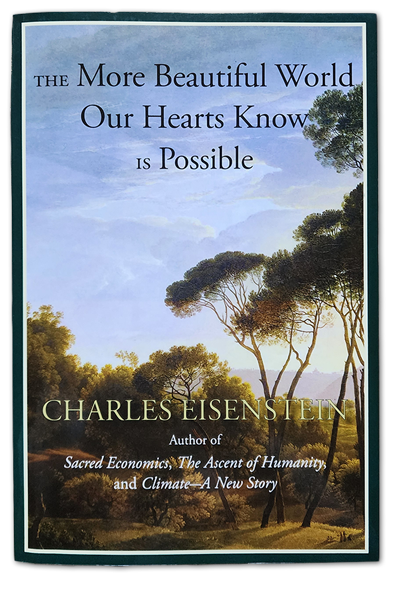
Highlights:
“…Human cultural evolution [is] a story of growth, followed by crisis, followed by breakdown, followed by a renaissance: the emergence of a new kind of civilization, an Age of Reunion to follow the Age of Separation. Perhaps profound change happens only through collapse. Certainly that is true for many on a personal level.1”
**pg. 3
“What… is sacred?2 Since the blind, ruthless pursuit of self interest is antisocial, it is important to overcome our biological programming and pursue ‘higher things.’ A holy person doesn’t succumb to the desires of the flesh. He or she takes the path of self-denial, of discipline, ascending into the realm of spirit or, in the secular version of this quest, into the realm of reason and the mind, principles and ethics. For the religious, to be sacred is to be otherworldly; the soul is separate from the body, and God lives high above the earth. Despite their superficial opposition, science and religion have agreed: the sacred is not of this world.”
**pg. 5
This isn’t a postulation of the author’s, but a stated false premise on which we have built our society.
“It is quite normal to fear what one most desires. We desire to transcend the Story of the World that has come to enslave us, that indeed is killing the planet. We fear that the end of that story will bring: the demise of much that is familiar.”
**pg. 8
“The breakdown of the old story is kind of a healing process that uncovers the old wounds hidden under its fabric and exposes them to the healing light of awareness. I am sure many people reading this have gone through such a time, when the cloaking illusions fell away: all the old justifications and rationalizations, the the old stories.3”
**pg. 13
“The desire to serve something transcending the separate self and the pain we feel from the suffering of others are two sides of the same coin. Both bespeak our interbeingness.”
**pg. 17
“Appeals to authority will only strengthen authority… The master’s tools will never dismantle the master’s house… I am not some enlightened being trying to guide you on a journey he has already completed. That too is an old model, partaking of a kind of spiritual hierarchy based on a linear conception of the evolution of consciousness.”
**pg. 23
“The derision of the cynic comes from a wound of crushed idealism and betrayed hopes. We received it on a cultural level when the Age of Aquarius morphed into the age of Ronald Reagan, and on an individual level as well when our youthful idealism that knew a more beautiful world was possible, that believed in our own individual destiny to contribute something meaningful to the world, that would never sell out under any circumstances and would never become like our parents gave way to an adulthood of deferred dreams and lowered expectations. Anything that exposes this wound will trigger us to protect it. One such protection is cynicism, which rejects and derides as foolish, naive, or irrational all of the expressions of reunion.”
**pg. 25
“I wish I could rely on evidence to choose my belief. But I cannot… Absent conclusive evidence, you will have to decide on some other basis, such as ‘Which story is most aligned with who you truly are, and who you truly want to be?’ ‘Which story gives you the most joy?’ ‘From which story are you most effective as an agent of change?‘”
**pg. 27
“We like to think that we base our beliefs on evidence, but far more often we arrange the evidence to fit our beliefs, surrounding ourselves with others who share them.”
**pg. 28
”If your life’s work does not contribute to the conversion of nature into products and relationships into services, you may often find that there isn’t much money to be made doing it.” ^quote10
**pg. 28
“As things fall apart and the old story releases its thralls into the space between stories, the beautiful music of our choir will beckon, and they will come join us in song. We have been doing important work, first in loneliness, then in small, marginal groups. The time is upon us for the new Story of the People to leave the incubator. When things fall apart, the hopelessly radical becomes common sense.”
**pg. 31
“The same interbeingness that makes us so immensely vulnerable also makes us so immensely powerful. Remember this! Indeed the vulnerability and the power go hand in hand, because only by relaxing the guard of the separate self can we tap into power beyond its ken. Only then can we accomplish things that are, to the separate self, impossible. Put another way, we become capable of things we don’t know how to ‘make’ happen.”
**pg. 32
“Our customary understanding of what is practical is grounded in a worldview, a mythos, that is rapidly becoming obsolete. Furthermore, that obsolescing worldview is precisely the one underlying the old world we strive to change. In other words, the crisis of civilization and the despair over the crisis share a common source… The old story has finally reached the end of its telling, and the space is clear for a new story to emerge. This cannot happen while the old story still carries hope. If anything in the old world’s ‘practical’ still has any hope of succeeding, that means the old story has life in it still.”
**pg. 38
“We only keep performing the tasks that keep the world-devouring machine running by quelling that feeling of significance. We steel ourselves to do what some abstract reasoning tells us we must do, in the interests of practicality. Occasionally, this ‘practicality’ means ‘what will help heal the ecosystem, bring about social justice, and enable the survival of our species,’ but for most people, most of the time, practicality involves money or other means of security and comfort. And money, in our current system, generally comes through our participation in the conversion of nature into products, communities into markets, citizens into consumers, and relationships into services. If your hear isn’t in all that, you will find that practicality often contradicts the urging of the heart. ”
**pg. 53
“I think it is better not to obscure the despair, because real hope lies only on its other side. Despair is part of the territory we must traverse… True optimism comes from having traversed the territory of despair and taken its measure.”
**pg. 55
“So many people squelch the expression of their gifts by thinking that they must do something big with them. One’s own actions are not enough—one must write a book that reaches millions. How quickly this turns into a competition over whose ideas get heard. How it invalidates the small, beautiful strivings of the bulk of humanity; invalidates, paradoxically, the very things that we must start doing en masse to sustain a livable planet.”
**pg. 59
Morphic Resonance
“One of the ways that your project, your personal healing, or your social invention can change the world is through story. But even if no one ever learns of it, even if it is invisible to every human on Earth, it will have no less of an effect… I am not suggesting that we therefore repudiate conventional means for the propagation of our work. I am advocating a kind of confidence in the significance of all that we do, even when our vision cannot penetrate the mysterious, meandering paths through which our actions arrive in the larger world… Please don’t think you ‘have to write a book about it’ for your experiences to have a large effect.”
**pg. 62-63
“The book may come, the peacebuilding project documentary might come, but usually there must first be a latency, a time of doing something for its own sake, a time of inward focus on the goal and not the ‘meta’ goal. The magic comes from that place. From there, the synchronicities flow; there is no sense of forcing, only of participating in a larger happening that seems to have an intelligence of its own.”
**pg. 64
“So many voices lobby us to forget love, forget humanity, sacrifice the present and the real for the sake of what seems more practical. Herein lies the medicine of despair: by evacuating our illusions and practicality, it reconnects us to the present needs at hand and allows those senseless, impractical acts that generate miracles.”
**pg. 64
“The universe calls forth different of our gifts at different moments. When the call is for the small and personal, let us heed that, so that we develop the habit of heeding it when it is big and public. Let’s cease listening to the logic of Separation, which would devalue the small and personal.”
**pg. 65
“Only when someone believes ‘I can do it,’ will they even try. When our beliefs change, so do our motivations and perceptions. We do new things and see new opportunities.”
**pg. 77
“It is not ours to decide what is true or possible. Some teachings ask us to start by creating a visions, but this is mistaken; the proper way to start is to receive a vision. I call it ‘The vision of that which wants to be born.’4 Not having invented it ourselves, we sense that it has a beingness of its own. Doubts may still assail us, but underneath the doubts there will be a knowing that comes from having seen something.”
**pg. 78
“The first step in creating change, then, is to receive a vision that feels true. The seconds step is to heal the wounds and doubts that vision illuminates. Without doing that, we will be conflicted, simultaneously enacting both the new story and the old one that accompanies the wounds. The third step is to bow in service to what wants to be born. This process is not linear. Usually, the vision comes more and more into focus as we heal the doubts that obscure it; that, in turn, brings up new dimensions of the vision along with deeper wounds. The path of service is a path of self-realization.”
**pg. 78
”When we are in service to something real, when we speak of it our words have power. Others can feel its reality too.” ^quote24
**pg. 78
“To be fully in service to something one has experienced as real is the essence of leadership in a nonhierarchical age. A leader is the holder of a story, someone whose experience of its reality is deep enough so that she can hold the belief on behalf of others.”
**pg. 79
“The deeper the service to that which wants to be born, the more it is able to arrange the synchronistic encounters and fortuitous events that allow us to accomplish that which lies beyond our understanding of cause and effect. We might say that the primary ‘technology’ of the Age of Reunion is service. We offer our time, energy, skills, and lives as gifts, stepping into trust, letting go of the habit of looking first and foremost after one’s self. Only then can we fully align with the vision. From that alignment, a tremendous force is born. Our expanded selves are far more powerful and less fearful than the discrete, separate individual who, separate from the world, can only manipulate it by force, and looks with wariness and wonder at the amazing coincidences that line up as it lets go and plunges into service. Obviously, since these are not things that we know how to ‘make’ happen, they happen as gifts, confirming the universal principle of the gift: that giving and receiving always come into balance in the end.”
**pg. 79
“Why are we so desperate to escape the material world? Is it really so bleak? Or could it be, rather, that we have made it bleak: obscured its vibrant mystery with our ideological blinders, severed its infinite connectedness with our categories, suppressed its spontaneous order with our pavement, reduced its infinite variety with our commodities, shattered its eternity with our time-keeping, and denied its abundance with our money system? If so, then we are misguided if we appeal to a non-material spiritual realm for our salvation from the prison of materiality.”
**pg. 83
“Evidence and logic are tools we use to justify and flesh out our beliefs, but we are deceiving ourselves to think that they are the source of our beliefs.”
**pg. 94
“There is a time to act, and a time to wait, to listen, to observe. Then understanding and clarity can grow. From understanding, action arises that is purposeful, firm, and powerful.”
**pg. 105
“It is not that we spend half our lives in benighted impotence until we awaken to true understanding, purpose, and creative power. Instead, we go through phases when we believe in what we are doing, when life more or less makes sense, and when we hope and expect our efforts to bear fruit. And they do, for a time, but as we grow in that world we begin to question our assumptions. Our tools don’t work as well anymore; we cease believing in our goals or in the possibility of achieving them. We approach a resting phase, an empty phase.5 Immersed in a system that never lets us rest, that condemns laziness and pushes us toward ever-increasing busyness through economic pressure, we have trouble accepting this phase. We tell ourselves we must always be doing something. Time’s a-wastin’!”
**pg. 106
“You will notice that many of the habits of separation are familiar. Injunctions against them abound in mainstream religious teachings as well as popular morality. That is because religion and culture both carry seeds of reunion. But we find these teachings hard to live up to because they are inconsistent with the dominant myths and structures of civilization. Thus they become rules: prohibitions, prescriptions, etc., and therefore agents of a prime habit of separation, which is to conquer the self…
No wonder, trying to reconcile the rules with the world we have lived in, religious authorities divide the universe into two realms, the earthly and the heavenly, the material and the spiritual. Yes, they conceded, the material world is sinful, and our bodies, being of that world, are sinful as well, but there is something else, another world with different rules. To live according to those, we have to resist the ways of the material world and the flesh.”
**pg. 110-111
“Before they are able to enter a new story, most people—and probably most societies as well—must first navigate the passage out of the old.6 In between the old and the new there is an empty space. It is a time when the lessons and learnings of the old story are integrated. Only when that work has been done is the old story really complete. Then, there is nothing, the pregnant emptiness from which all being arises.7 Returning to essence, we regain the ability to act from essence. Returning to the space between stories, we can choose from freedom and not from habit. ”
**pg. 121