
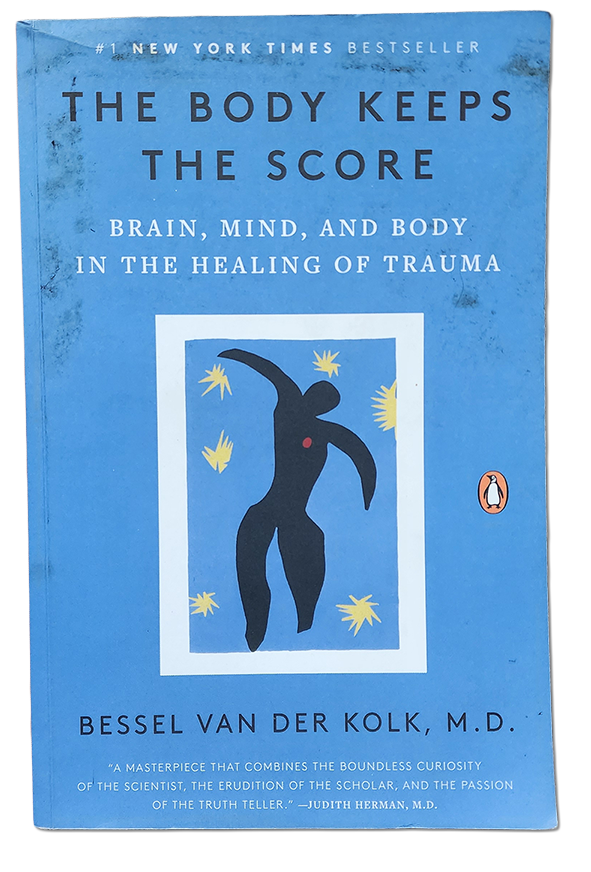
Highlights:
“…Trauma compromises the brain area that communicates the physical, embodied feeling of being alive.”
pg. 3
“The greatest sources of our suffering are the lies we tell ourselves.”
pg. 11
“He felt emotionally distant from everybody, as though his heart were frozen and he were living behind a glass wall.”
pg. 14
“After trauma the world becomes sharply divided between those who know and those who don’t. People who have not shared the traumatic experience cannot be trusted, because they can’t understand it. Sadly, this often includes spouses, children, and co-workers.”
pg. 18
“Healing… depends on experiential knowledge: You can be fully in charge of your life only if you can acknowledge the reality of your body, in all its visceral dimensions.”
pg. 27
“The brain-disease model overlooks four fundamental truths: (1) our capacity to destroy one another is matched by our capacity to heal one another. Restoring relationships and community is central to restoring well-being; (2) language gives us the power to change ourselves and others by communicating our experiences, helping us to define what we know, and finding a common sense of meaning; (3) we have the ability to regulate our own physiology, including some of the so-called involuntary functions of the body and brain, through such basic activities as breathing, moving, and touching; and (4) we can change social conditions to create environments in which children and adults can feel safe and where they can thrive.”
pg. 38
“During disasters young children usually take their cues from their parents. As long as their caregivers remain calm and responsive to their needs, they often survive terrible incidents without serious psychological scars.”
pg. 52
“The most important job of the brain is to ensure our survival, even under the most miserable conditions. Everything else is secondary. In order to do that, brains need to: (1) generate internal signals that register what our bodies need, such as food, rest, protection, sex, and shelter; (2) create a map of the world to point us where to go to satisfy those needs; (3) generate the necessary energy and actions to get us there; (4) warn us of dangers and opportunities along the way; and (5) adjust our actions cased on the requirements of the moment.”
pg. 55
“Psychological problems occur when our internal signals don’t work, when our maps don’t lead us where we need to go, when we are too paralyzed to move, when our actions do not correspond to our needs, or when our relationships break down.”
pg. 55
“You can get along with other people only if you can accurately gauge whether their intentions are benign or dangerous. Even a slight misreading can lead to painful misunderstandings in relationships at home and at work.”
pg. 62
“Knowing the difference between top down and bottom up regulation is central for understanding and treating traumatic stress. Top-down regulation involves strengthening the capacity of the watchtower to monitor your body’s sensations. Mindfulness meditation and yoga can help with this. Bottom-up regulation involves recalibrating the autonomic nervous system… We can access the ANS through breath, movement, or touch.”
pg. 64
“Our self-experience is the product of the balance between our rational and our emotional brains… The neuroscientist Paul MacLean… compared the relationship between the rational brain and the emotional brain to that between a more or less competent rider and his unruly horse. As long as the weather is calm and the path is smooth, the rider can feel in excellent control. But unexpected sounds or threats from other animals can make the horse bolt, forcing the rider to hold on for dear life.”
pg. 64