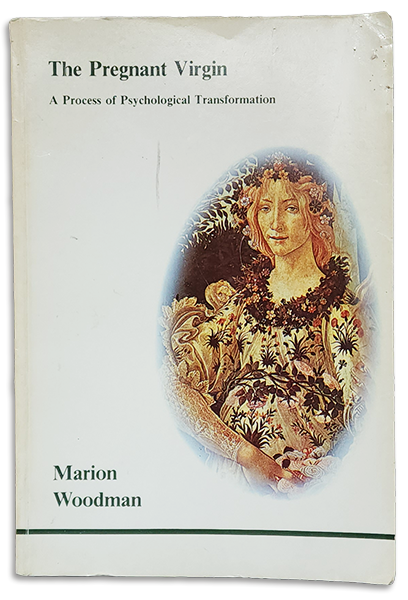
Highlights:
“No longer who we were, we know not who we may become. We experience ourselves as living mush, fearful of the journey down the birth canal. The whole has to do with the process of psychological pregnancy—the virgin forever a virgin, forever pregnant, forever open to possibilities.”
**pg. 7
“I want to write, but I don’t want to write essays. I want to write my way.”
**pg. 8
I have had this exact thought.
“The chrysalis only looked dead. Remarkable changes were happening inside. A caterpillar’s life was very different from a butterfly’s, and they needed very different bodies… Most of the caterpillar’s organs would dissolve, and those fluids would help the tiny wings, eyes, muscles and brain of the developing butterfly to grow. But that was very hard work, so hard that the creature could accomplish nothing else so long as it was going on.”
**pg. 13
“Many delightful babies appear in dreams, and just as many little tyrants who need firm and loving discipline. One child, however, is noticeably different from the others. This is the abandoned one, who may appear in bullrushes, in straw in a barn, in a tree, almost always in some forgotten or out-of-the-way place. This child will be radiant with light, robust, intelligent, sensitive. Often it is able to talk minutes after it is born. It has presence. It is the Divine Child, bringing with it the ‘hard and bitter agony’ of the new dispensation—the agony of Eliot’s Magi. With its birth, the old gods have to go.”
**pg. 23
“As life progresses, we may continue abandon our child by pleasing others—teachers, professors, bosses, friends and partners, even analysts. That child who is our very soul cries out from underneath the rubble of our lives, often from the core of our worst complexes, begging us to say, ‘You are not alone. I love you.‘”
**pg. 25
“The body’s memory, stored in muscle and bone, fuses the desire to connect and the desire to escape so they are simultaneously present in an undifferentiated form. The result—an identity of opposites—manifests as despair: nothing can be done and everything must be endured.”
**pg. 38
“Well, this time I won’t build up my false persona. It can’t relate because it can’t feel. I have to experience my vulnerability. I have to allow others to know how vulnerable I am.”
**pg. 43
“If healing is to take place, she must not act like a gentleman; she must not try to understand why he is abandoning her. She is angry and her rage is killer-rage and killer-jealousy that needs an acceptable channel. The pent-up fury of a lifetime has to be released from the body to make room for the healing love. That personal rage has to be acknowledged and experienced before the transpersonal understanding and compassion can flow in. Somewhere in that anguish and anger, the woman will realize that she has not been abandoned by the man she loves. The man she loves does not exist in human form. He never did. She has been projecting an inner image of her own. Her mirror has shattered, and now she can either die or accept reality. And the reality is that she does not grieve for that actual man. She grieves both for her perfect lover and for the beautiful woman she was when she was in love.”
**pg. 45-46
“The woman who is in touch with her inner virgin has passed the frontier of the anima woman operating out of a male psychology. She finds herself saying things she never said before, verbalizing questions she never asked before. She tries to speak from her feminine reality while at the same time aware of the masculine standpoint. Often she is caught between two conflicting points of view: the rational, goal-oriented and just, versus the irrational, cyclic, relating. Her taks is not to choose one or the other, but to hold the tension between them A woman who has devoted her life to examinations and scholarship, or politics or the business world, knows how to organize her mind in obedience to the laws of unity, coherence, and emphasis. What she too often has lost in such training is faith in the values that come from the heart. When she attempts to speak from that place, she contacts her abandoned soul. Fearful of appearing ‘childish and stupid,’ she feels her face going red, clutches at her neck to try to get the words out; breathlessly she plummets on, hoping she won’t be stopped, hoping she won’t lose her vocabulary and collapse in confusion. She is trying desperately to articulate her feminine Being, trying to transcend the either/or prison that locks her into contradiction. The either/or model is now as untenable as Newtonian physics. Just as the world of science has come to accept that light is at once both wave and particle—depending on the experiment used to determine its nature—so women must learn to live in a world of paradox, a world where two mutually exclusive views of reality may be held at the same time. The rhythms there are circuitous, slow, born of the feeling that comes from the thinking heart. Many people intuitively know that such a place exists; few have the confidence to talk or walk from that center.”
**pg. 51