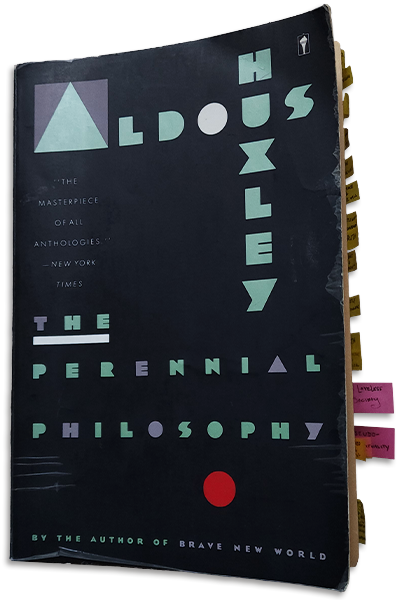
Highlights:
“Knowledge is a function of being. When there is a change in the being of the knower, there is a corresponding change in the nature and amount of knowing.” - Aldous Huxley, The Perennial Philosophy
pg. ?
“Fear, worry, anxiety these form the central core of individualized selfhood. Fear cannot be got rid of by personal effort, but only by the ego’s absorption in a cause greater than its own interests. Absorption in any cause will rid the mind of some of its fears; but only absorption in the loving and knowing of the divine Ground can rid it of all fear.” - Aldous Huxley, The Perennial Philosophy
pg. ?
“The simplicity and spontaneity of the perfect sage are the fruits of mortification - mortification of the will and, by recollectedness and meditation, of the mind. Only the most highly disciplined artist can recapture, on a higher level, the spontaneity of the child with its first paint-box. Nothing is more difficult than to be simple.” - Aldous Huxley, The Perennial Philosophy
pg. ?
”… the Atman, or the immanent eternal Self, is one with Brahman, the Absolute Principle of all existence; and the last end of every human being is to discover the fact for himself, to find out Who he really is.” - Aldous Huxley, The Perennial Philosophy
pg. 2
“Each being contains in itself the whole intelligible world. Therefore All is everywhere. Each is there All, and All is each. Man as he now is has ceased to be the All. But when he ceases to be an individual, he raises himself again and penetrates the whole world.” - Plotinus, The Perennial Philosophy
pg. 5
”The nature of the one Reality must be known by one’s own clear spiritual perception; it cannot be known through a pandit (learned man). Similarly the form of the moon can only ben known through one’s own eyes. How can it be known through others?” - Shankara, The Crest-Jewel of Wisdom The Perennial Philosophy ^quote5
pg. 5
“Liberation cannot be achieved except by the perception of the identity of the individual spirit with the universal Spirit. It can be achieved neither by Yoga (physical training) nor by Sankhya (speculative philosophy), nor by the practice of religious ceremonies, nor by mere learning… Disease is not cured by pronouncing the name of medicine, but by taking medicine. Deliverance is not achieved by repeating the word ‘Brahman’, but by directly experiencing Brahman… The Atman is the Witness of the individual mind and its operations. It is absolute knowledge…” - Shankara, The Crest-Jewel of Wisdom The Perennial Philosophy
pg. 6
”When a man follows the way of the world, or the way of the flesh, or the way of tradition (i.e. when he believes in religious rites and the letter of the scriptures, as though they were intrinsically sacred), knowledge of Reality cannot arise in him.” - Shankara, The Crest-Jewel of Wisdom The Perennial Philosophy ^quote7
pg. 7
“Do not ask whether the Principle is in this or in that; it is in all beings. It is on this account that we apply to it the epithets of supreme, universal, total… It has ordained that all things should be limited, but is Itself unlimited, infinite. As to what pertains to manifestation, the Principle causes the succession of its phases, but is not this succession. It is the author of causes and effects, but is not the causes and effects. It is the author of condensations and dissipations (birth and death, changes of state), but is not itself condensations and dissipations. All proceeds from It and is under its influence. It is in all things but is not identical with beings, for it is neither differentiated nor limited.” - Chuang Tzu, The Book of Chuang Tzu, The Perennial Philosophy
pg. 7-8
“Those who vainly reason without understanding the truth are lost in the jungle of the Vijnanas (the various forms of relative knowledge), running about here and there and trying to justify their view of ego-substance.” - Lankavatara Sutra, The Perennial Philosophy
pg. 8
”The politics of those whose goal is beyond time are always pacific; it is the idolators of past and future, of reactionary memory and Utopian dream, who do the persecuting and make the wars.” - The Perennial Philosophy ^quote10
pg. 11
“If most of us are ignorant of ourselves, it is because self-knowledge is painful, and we prefer the pleasures of illusion.” - Aldous Huxley, The Perennial Philosophy
pg. ?
“It is because we don’t know Who we are, because we are unaware that the Kingdom of Heaven is within us, that we behave in the generally silly, the often insane, the sometimes criminal ways that are so characteristically human. We are saved, we are liberated and enlightened, by perceiving the hitherto unperceived good that is already within us, by returning to our eternal Ground and remaining where, without knowing it, we have always been.” - Aldous Huxley, The Perennial Philosophy
pg. 14
“Our perceptions and our understanding are directed, in large measure, by our will. We are aware of, and we think about, the things which, for one reason or another, we want to see and understand. Where there’s a will there is always an intellectual way. The capacities of the human mind are almost indefinitely great. Whatever we will to do, whether it be to come to the unitive knowledge of the Godhead, or to manufacture self-propelled flame-throwers—that we are able to do, provided always that the willing be sufficiently intense and sustained.” - Aldous Huxley, The Perennial Philosophy
pg. 17
“…Much of the world’s most original and fruitful thinking is done by people of poor physique and of a thoroughly unpractical turn of mind. Because this is so, and because the value of pure thought, whether analytical or integral, has everywhere been more or less clearly recognized, provision was and still is made by every civilized society for giving thinkers a measure of protection from the ordinary strains and stresses of social life. The hermitage, the monastery, the college, the academy and the research laboratory; the begging bowl, the endowment, patronage and the grant of taxpayer’s money—such are the principal devices that have been used by actives to conserve that rare bird, the religious, philosophical, artistic or scientific contemplative. In many primitive societies conditions are hard, and there is no surplus wealth. The born contemplative has to face the struggle for existence and social predominance without protection. The result, in most cases, is either that he dies young, or is too desperately busy merely keeping alive to be able to devote his attention to anything else. When this happens, the prevailing philosophy will be that of the hardy, extroverted man of action.” - Aldous Huxley, The Perennial Philosophy
pg. 18
“The last end of man, the ultimate reason for human existence, is unitive knowledge of the divine Ground—the knowledge that can come only to those who are prepared to ‘die to self’ and so make room, as it were, for God.” - Aldous Huxley, The Perennial Philosophy
pg. 21
“Things are a great deal better when the transcendent, omnipotent personal God is regarded as also a loving Father. The sincere worship of such a God changes character as well as conduct, and does something to modify consciousness. But the complete transformation of consciousness, which is ‘enlightenment,’ ‘deliverance,’ ‘salvation,’ comes only when God is thought of as the Perennial Philosophy affirms Him to be—immanent as well as transcendent, supra-personal as well as persona—and when religious practices are adapted to this conception.” - Aldous Huxley, The Perennial Philosophy
pg. 23
“We can understand something of what lies beyond our experience by considering analogous cases lying within our experience. Thus, the relations subsisting between the world and God and the Godhead seem to be analogous, in some measure at least, to those that hold between the body (with its environment) and the psyche, and between the psyche and the spirit.” - Aldous Huxley, The Perennial Philosophy
pg. 24
In other words: The world is to God what the body is to the psyche. God is to the Godhead what the psyche is to the spirit.
“The ground in which the multifarious and time-bound psyche is rooted is a simple, timeless awareness. By making ourselves pure in heart and poor in spirit we can discover and be identified with this awareness. In the spirit we not only have, but are, the unitive knowledge of the divine Ground.” - Aldous Huxley, The Perennial Philosophy
pg. 29
“For, as all exponents of the Perennial Philosophy have constantly insisted, man’s obsessive consciousness of, and insistence on being a separate self is the final and most formidable obstacle to the unitive knowledge of God. To be a self is, for them, the original sin, and to die to self, in feeling, will and intellect, is the final and all-inclusive virtue.” - Aldous Huxley, The Perennial Philosophy
pg. 36