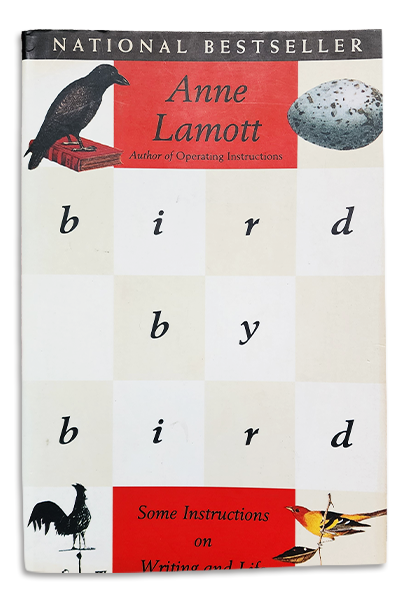
Highlights:
“If you weren’t enough before you published, you won’t be enough after.” - Anne Lamott
“(My students will) see the world through new eyes. Everything they see and hear and learn will become grist for the mill. At cocktail parties or in line at the post office, they will be gleaning small moments and overheard expressions: they’ll sneak away to scribble these things down.” - Anne Lamott
“…And the story begins to materialize, and another thing is happening, which is that you are learning what you aren’t writing, and this is helping you to find out what you are writing. Think of a fine painter attempting to capture an inner vision, beginning with one corner of the canvas, painting what he thinks should be there, not quite pulling it off, covering it over with white paint, and trying again, each time finding out what his painting isn’t, until he finds out what it is.” - Anne Lamott
*page 9
“I wish I felt that kind of inspiration more often. I almost never do. All I know is that if I sit there long enough, something will happen.” - Anne Lamott
page 10
“E. L. Doctorow once said that ‘writing a novel is like driving a car at night. You can only see as far as your headlights, but you can make the whole trip that way.’ You don’t have to see where you’re going, you don’t have to see your destination or everything you will pass along the way. You just have to see two or three feet ahead of you.” - Anne Lamott
page 18
“Writing can be a pretty desperate endeavor, because it is about some of our deepest needs: our need to be visible, to be heard, our need to make sense of our lives, to wake up and grow and belong.” - Anne Lamott
page 19
“Almost all good writing begins with terrible first efforts. You need to start somewhere. Start by getting something - anything - down on paper. A friend of mine says that the first draft is the down draft - you just get it down. The second draft is the up draft - you fix it up. You try to say what you have to say more accurately. And the third draft is the dental draft, where you check every tooth, to see if it’s loose or cramped or decayed, or even, God help us, healthy.” - Anne Lamott
page 25-26
“So go ahead and make big scrawls and mistakes. Use up lots of paper. Perfectionism is a mean, frozen form of idealism, while messes are the artist’s true friend. What people somehow (inadvertently, I’m sure) forgot to mention when we were children was that we need to make messes in order to find out who we are and why we are here - and, by extension, what we’re supposed to be writing.” - Anne Lamott
page 32
“Writing a first draft is very much like watching a Polaroid develop. You can’t—and, in fact, you’re not supposed to—know exactly what the picture is going to look like until it has finished developing.” - Anne Lamott
page 39
“One image that helps me begin to know the people in my fiction is something a friend once told me. She said that every single one of us at birth is given an emotional acre all our own. You get one, your awful Uncle Phil gets one, Tricia Nixon gets one, everyone gets one. And as long as you don’t hurt anyone, you really get to do with your acre as you please. You can plant fruit trees or flowers or alphabetized rows of vegetables, or nothing at all. If you want your acre to look like a giant garage sale, or an auto-wrecking yard, that’s what you get to do with it. There’s a fence around your acre, though, with a gate, and if people keep coming onto your land and sliming it or trying to get you to do what they think is right, you get to ask them to leave. And they have to go, because that’s your acre.” - Anne Lamott
page 44
“…Look within your own heart, at the different facets of your personality: You may find a con man, an orphan, a nurse, a king, a hooker, a preacher, a loser, a child, a crone. Go into each of these people and try to capture how each one feels, thinks, talks, survives.” - Anne Lamott
page 46
“Now, a person’s faults are largely what make him or her likable.” - Anne Lamott
page 50
“If you are a writer, or want to be a writer, this is how you spend your days—listening, observing, storing things away, making your isolation pay off. You take home all you’ve taken in, all that you’ve overhead, and you turn it into gold.” - Anne Lamott
page 66
“My friend Carpenter talks about the unconscious as the cellar where the little boy sits who creates the characters, and he hands them up to you through the cellar doo. He might as well be cutting out paper dolls. He is peaceful: he’s just playing. You can’t will yourself into being receptive to what the little boy has to offer, and you can’t buy a key that will let you into the cellar. You have to relax, wool-gather, and get rid of the critics, and sit there in some sort of self-hypnosis, and then you have to practice. I mean, you can’t just sit there at your desk drooling. You have to move your hand across the paper or keyboard. You may do it badly for a while, but you keep on doing it. Try to remember that to some extent, you’re just the typist. A good typist listens.” - Anne Lamott
page 72
“Writing is about learning to pay attention and to communicate what is going on.” - Anne Lamott
page 97
“The writer is a person who is standing apart, like the cheese in ‘The Farmer in the Dell’ standing there alone but deciding to take a few notes. You’re outside, but you can see things up close through your binoculars. Your job is to present clearly your viewpoint, your line of vision. Your job is to see people as they really are, and to do this, you have to know who you are in the most compassionate possible sense. Then you can recognize others.” - Anne Lamott
page 97-98
This makes me think of what Virginia Woolf said:
“If you do not tell the truth about yourself you cannot tell it about other people”
“I honestly think in order to be a writer, you have to learn to be reverent. If not, why are you writing? Why are you here? Let’s think of reverence as awe, as presence in and openness to the world. The alternative is that we stultify, we shut down. Think of those times when you’ve read prose or poetry that is presented in such a way that you have a fleeting sense of being starteld by beauty or insight, by a glimpse into someone’s soul. All of a sudden everything seems to fit together or at least have some meaning for a moment. This is our goal as writers, I think; to help others have this sense of—please forgive me—wonder, of seeing things anew, things that can catch us off guard, that break in on our small, bordered worlds..” - Anne Lamott
page 99-100