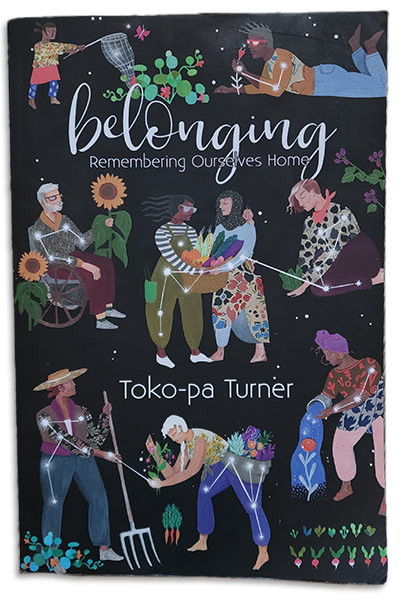
Highlights:
“Whether it is the yearning to find our true place, our people, or a meaningful relationship, the longing to belong is the great silent motivator behind so many of our other ambitions.”
pg 16
“And so we treat our lives like a project for improvement, attempting to become useful, admired, impervious or savvy. We work at cutting off any unwieldiness that may be preventing us from fitting in. But as this ‘self-development’ encroaches upon our inner wilderness, our dreams and our connection to the holy suffers. As we harness every last resource in service to the unconscious longing to belong, we feel less and less at home.”
pg 17
“Before we even ask ourselves how to heal our estrangement, we must first sink down into the wound itself and apprentice ourselves to it. We must enter into the question of what has been missing from us. Of what are we being deprived? Only when we lower ourselves down into that holy longing can we get a glimpse of the majesty we are meant to become.”
pg 17
“The production of symbols and story is a biological necessity. Without dreams, we could not survive. And though it is possible to get by without remembering our dreams, a life guided and shaped by dreaming is a life that follows the innate knowing of the earth itself.”
pg 18
”If you can stand fully in your own unbelonging and become friendly with the terrors of loneliness and exclusion, you can no longer be governed by your avoidance of them. In other words, you are on your way home.”
pg 25
“Though the outcast learns to shift her shape to suit any habitat, it makes it harder to know her own true colors. She may feel free from imagined or real constraints, but also yearn to trust a place, people, or vocation enough to invest her roots down into its soil. And that kind of aloneness, which knows no enduring home, can exact a toll over time.”
pg 28
“But without the help of dreams and fairy tales to navigate these symbolic departures, the outcast may get stuck in a lifetime identification with the unredeemed archetype.”
pg 30
“(Orphans) are a manifestation of loneliness, but they also represent the possibility for humans to reinvent themselves.”
pg 30
“During this time of wandering, she will at times be overcome with hardship and feel close to giving up. But if she summons the wit and virtue to hold her own standpoint, magical allies will show up to assist her. In the end, her triumph is a place of belonging in the world that is unimpeachable, not only because she has wrought it from scratch, but because it is large enough to shelter others.”
pg 31
“But when you live in a ‘trauma world,’ your responses are generated by a compromised nervous system, which assumes you are always under threat of being attacked or abandoned even if there’s no real danger… Life is experienced as a minefield in which we are knocked down by explosions that are inaudible to others. If there is unconscious hostility in the environment, the inner body, acting autonomously, retreats and falls over ‘dead’.“
pg 36
“The habit of unworthiness is a kind of splitting-off causing us to show up only partially for life; worthiness is felt in direct proportion to our ability to live an integrated life. Rather than outcasting the parts of ourselves which were once rejected, we work to reclaim those parts of ourselves that are afraid of being seen, hurt, or left behind. We allow and include them, moment by moment, strengthening our capacity for inclusion, for belonging. It is the practice of bringing the fullness of our presence to a moment, whether it’s filled with rage or an upwelling of sadness, to say, ‘This too belongs.‘“
pg 41
”So long as we keep aspects of ourselves hidden from view because we believe only an edited or presentational version of who we are will be accepted by others, we are depriving ourselves of belonging. But also—and here’s the piece that takes some real practice to see—depriving others of belonging with us.”
pg 42
“But what if worthiness depends on our belonging together? Worth is really another way of saying ‘plenty.’ It is the resting state of abundance. This is our natural state when we live in solidarity with others and in harmony with our environment. When we each contribute our unique gifts and abilities to the whole, we always have more than we need. Conversely, when things go wrong, we shoulder it together, lessening the load for us all.”
pg 42
“For individuals, this may look like reclaiming those aspects of the feminine which are missing from the Good Mother: our disagreeability, our impatience, our anger, our isolation, our desperation for support. In these places lives a hidden power that, if wielded consciously, can become an ally to us instead of a destructive impulse.”
pg 43
“In order to heal the scarcity wound—created by the lack of nurturing both in our families and in our culture—we must learn to become the loving mother to ourselves that we never had. This ‘remothering’ is the ongoing practice, tremendously helped by a mentor, of learning to care for your body’s needs, validating and expressing your feelings (even if they’re unpopular), holding healthy boundaries, supporting your life choices, and most of all—being welcoming towards all that is yet unsolved in your heart.”
pg 44
“Often when your pole star begins to rise, people in your family or community will dismiss, underestimate, even criticize you at that pivotal juncture. One of the great silent contracts of false belonging is that you remain a follower. As soon as you try to step into a leadership role, you meet with resistance. The group feels threatened by the emerging sexuality, the charisma, intelligence, or creativity that shakes up the order of things. On some level your rising star may be interpreted as another’s demotion of loss of relevance.”
pg 47
“Silence is a power because it keeps what’s tender, what’s vulnerable, away from scrutiny, criticism, dismissal, interruption, and exile. The keeper of silence has tremendous control. What she keeps sealed away can never be harmed so long as it remains hidden. Silence is a power, yes, but when does silence turn upon its keeper and become the captor? When does it inhibit the natural impulse to speak, the urge to sing, the longing to contribute?“
pg 49
”… Only when one is willing to make a few mistakes can something beautiful be discovered.”
pg 50
“The only antidote to perfectionism is to turn away from every whiff of plastic and gloss and follow our grief, pursue our imperfections, and exaggerate our eccentricities until the things we once sought to hide reveal themselves as our majesty.”
pg 50
“I meet so many women in my work who have gorgeous ideas but are terrified to release them into the world. This terror is a combination of things, but at the fundamental level it is the fear of criticism. The inner critic, a spokesperson for all the diminishing voices in our past and in our culture, is the first gatekeeper of true belonging.”
pg 51
“The feminine voice comes from the body’s knowing. It is the writing of aches and ragged breath and dirty fingernails from climbing out of the underworld. It is the sonority of our words that is primary, not their definition. This voice is the howling of a child for its mother before language is even learned. It doesn’t strive for objectivity, which is removed from feeling, but rather sings us deeper into the much of it. It takes things personally. And it gives things personally it return. There is no such thing as impartiality when you live in the body; it speaks from the flesh and bone rhythms of that first belonging. It knows the secret loophole: you cant argue with poetry.”
pg 52-53
“Nature is always calling us into greater gestures of bravery. And as we accept those invitations to our personal edge, we lose the ability to shrink into falseness. The practice above all practices is to relinquish the immature desire to be taken care of in false belonging and to parent our own originality. Again and again, our dreams demand leadership from us, calling our life’s vision forward into the world, step by tenderbrave step.”
pg 53
“We must remember that the feminine works in a nonlinear fashion. While many are impatiently looking in dream dictionaries for the bottom-line, the final answer, the key to their liberation, they rarely find anything enduring. This is because there is a greater genius at work, one that we could never understand all at once. Instead we must follow a mysterious trail of breadcrumbs prompting us to take greater and greater leaps into the unknown, to build our trust in that which is parenting us. One day, sometimes years down the line, we finally understand how the symphony resolves itself.”
pg 62
“To rescue the feminine in our lives we must follow where the energy wants to go.”
pg 63
“This is what we might call the Great Forgetting. It is the rupture that each of us feels in our lives; that place of wounding where we override our bodies, ignore our intuitions, and supplant our inner knowing with ‘other people’s information.’”
pg 64
“…there is an important story needing to come through each of us. We are longing to be seen, to be necessary, to belong to our community. But the only way a community can heal itself is to draw out the story coming through every individual. Only when we recognize the events of our lives, and of those who went before us, as leading us in a meaningful direction can we pick up the threads of our story in present time and weave it forward with common purpose.”
pg 64
“Initiation often brings us into the core wounds of our past, inviting us, through a portal in present time, into the unresolved traumas of our own lives and those of our ancestral lines.”
pg 70
“The compromise you cannot make is often what leads to initiation. It says, ‘Will you stand by this? Will you bear the process of attrition? Will you find what’s true within and vow to protect it/ Will you trust in the unknown enough to let it carry you into new ranges of belonging?’”
pg 70
“Though exile can be the end of an established way of life for the initiate, through the mythic lens it is a beginning, a turning towards the soul. In many shamanic traditions, healers are initiated by way of extreme crisis and illness. The ‘healing crisis’ is considered a rite of passage for shamans-to-be. To even the most reluctant of initiates, it is a calling to the inner life, the world of Eros, dreams, and mystery. The process is long, involves a rigorous series of tests, and brings a slow retrieval of the lost or captive parts of the wounded healer’s soul. But if the initiate enters consciously into this initiation, he or she will learn its landscape well and become a skilled guide of these thresholds for others.”
pg 71-72
“Nobody goes willingly into initiation. By its very nature, initiation is a humbling of the will. It comes as a tsunami would, wild with nature, shattering us on all levels. And though every part of us may mount resistance to being changed, we are not meant to emerge intact. We are not meant to re-cover what has been revealed. Rather, we are meant to be dis-illusioned, dis-solved, dis-appointed before any thought of rebuilding can begin.”
pg 72
“But as the Persian poet Hafiz warns, ‘Don’t surrender your loneliness so quickly. Let it cut you more deep. Let it ferment and season you as few human and even divine ingredients can.’”
pg 73
“In order to make an honest encounter with the unknown, something of great value must be given up, lest we cling to an old version of ourselves. And in making that sacrifice, there is a transfer of power. In naming and releasing it, we own that which used to own us. The energy locked up in our conformity is liberated for our benefit and conscious use. Sometimes the sacrifice is of our own willfulness. In exile, we are invariably made vulnerable for a time so that we can perceive a more mythic calling. The challenge is to surrender our own plans for getting ahead so that the greater good can come through. If we can take a step outside of time, renouncing our ego’s urgency for progress, we have a chance at being danced, being sung into the greater song of things. This free fall is the turning point in the story when the heroine sees what she’s been missing. Sacrifice is a show of trust in the unknown. It is the pruning that redirects your energy toward the life of becoming. Like quitting a job only to have an opportunity appear the same afternoon, or breaking up a bad relationship only to meet your true love, there is magic in sacrifice. Life is calling you toward it, and your severance of the tethers that bind you to outgrown forms is the answering of that call. Your willingness to step into the emptiness from which all life springs is a show of devotion to your own belonging.”
pg 75
“Though we think of rebellion as warrior-like, it is really about making the self vulnerable in a heavily-armored world. The act of rebellion is to expose, and be exposed, in those places that have been kept hidden for too long. Because the rebel chooses to speak up with her voice or her action against tradition, she risks her life and the security of false belonging for the chance at being truly alive. In so doing, she incites aliveness in others.”
pg 77
“Those aspects of yourself that you discarded, set aside, ignored, and discouraged are the very things to which you must cling. The collective depends on the aggrandizing of your rejected qualities. The sooner you begin adopting your own difference, the sooner love can rush in to support you in raising your voice above the monotonous hum of the mainstream.”
pg 78
“What longing, if we undam it, might pound through our lives, bringing life to the dryness of an over-harvested creekbed within? What if there is a story coming through us which is trying to find its way into the world? If we can withstand the trials of exile, can we have the chance at turning that story into something that shows others that they aren’t alone?”
pg 78
“Her life’s destiny is to stand apart. But paradoxically, it’s only when she honors that apartness that she finally fits in… We must find the place within where things have been muted and give that a voice.”
pg 78
“It is the strangler fig’s tendency to send out its roots which, without any guiding influence, would choke the host for its own growth’s sake. Materialism, like the strangling vine, is not evil—but left unmitigated by a higher purpose, is dedicated only to its own invasive spread. It requires our intervention, a participatory weaving with the soul’s longing for beauty and meaning, so that it can become exalted in its service to the whole.”
pg 85
“Especially in times of exile, when our anchors are pulled up and we’re no longer taking cues from the outside world, we have a chance to find that inner well and reinstate our connection to the sacred.”
pg 87
”Unconsciously, we’re terrified to turn away from the world; we think we’re putting our ‘heads in the sand’ or that we’ll lose everything if we don’t keep pace. But the truth is that there is a different rhythm trying to temper us from within. If we shift our responsiveness from the outer to the inner world, allowing for a periodic ebbing of our external effectiveness, we come to see that it’s in service to a more harmonious way with our own bodies and with our greater earthbody.”
pg 87
“Strike a holy grove of silence where you can listen as you long to be heard, see as you long to be seen, recognize where you long to be relevant, needed, and necessary. Sink down into your estrangement, and let the grief of your disappointment be the moisture that baptizes the seeds of your potential so they can finally break open.”
pg 87
“Tending the inner well replenishes our devotion to the deep feminine aquifer for which our world is thirsting. When we recognize ourselves as a tributary of that greater upwelling, we allow things to be decided, spoken, and created not by us, but through us. In shifting our responsiveness to the inner call, rather than the outer one, our mission finds a sense of nobility in its service to the whole.”
pg 88
“Instinct is the part of us, as in all animals, that knows without thinking what and when to do something, how to respond, which way to go. Like the salmon that swims its way across hundreds of river miles to its birthplace, we too have inborn impulses that don’t require thinking to get us there. Instinct is our ‘right responsiveness’ guiding us towards our yesses, and away from our noes. It is through this instinctual nature that our soul’s medicine for the world flows. For many of us, however, this wilderness within has been so domesticated and harnessed for its resources that we barely recognize its call. But just as a plot of land can be rewilded by a kind of leaving it alone, so too can we rewild our psyches by ceasing ‘self-development’ and allowing mystery to work upon us.”
pg 90
“Many take the path well-worn, but they are only given a half-lived life. To those willing to brace the unknown path, the dark thicket, a remembering of love, magic, and purpose returns. There is a wild woman under our skin who wants nothing more than to dance until her feet are sore, sing her beautiful grief into the rafters, and offer the bottomless cup of her creativity as a way of life. And if you are able to sing from the very wound that you’ve worked so hard to hide, not only will it give meaning to your own story, but it becomes a corroborative voice for others with a similar wounding.”
pg 94
“Governed as we are by the great scientific quest to pull things apart to get at their mechanics, we find ourselves asking, ‘Yeah, but what does it mean? As if a dream could be summed up in a bottom line. But the truth is we aren’t moved or changed by the fast and dirty definition. What we really want is a relationship, a dialogue, a conversation with that place within us which always remains essentially mysterious. Rather than answering everything, it’s important to remember that there are certain questions that should be cherished. In dreamwork, there is a complex alchemy that brews in our not-knowing, which is essential to our becoming worthy of a dream’s revelation. As Dr. Clarissa Pinkola Estes tells us, there are those who used to refer to the dreammaker as the ‘Riddle Mother’ because when you carry your question into sleep, she responds to it with a riddle. Like any good fairy tale, the task is not to find a direction, but to let the quest shape you into the kind of person who knows which way to go.”
pg 95
“And as your instincts get stronger and clearer, your creativity begins teeming again, like a river undammed.”
pg 96
“(As children) Beguiled by wonder, creativity isn’t yet thought of as something we do so much as an unimpeded continual flowing through us. Creativity is our instinct to find and express new perspectives. And these idea-animals don’t come from the mind, nor do they come from a highly trained skill set: they come forth from the unconscious. Whether through dreams or ‘gap time’ in our schedules, creativity is something that natures through us when we give it the room it needs. ‘It takes a lot of time to be a genius,’ wrote Gertrude Stein, ‘you have to sit around so much doing nothing, really doing nothing.’”
pg 97
“Originality then becomes the practice of un-hindering what’s already there. This work is essential to belonging because your creative offering is like a holy signal to those who carry a similar vibratory signature. In hearing or seeing what you’ve created, they will find a sense of belonging with you and, by being found, so will you.”
pg 97
“True beauty always contains a delicious dash of chaos. It has a wild or unpredictable quality that takes you by surprise. Perfectionism tries to stamp out that quality in pursuit of an impeccability that strips a thing of its spontaneity. If we are seduced by it, it can chose all the life from our offering, turning it homogenous and agreeable.”
pg 98
“If creativity is doing its job well, it should bleed for us and, in bleeding, allow us to touch the ache of our own wounds. Similarly, our own creativity should draw upon the wisdom of our wounds if it wants to reach others in a meaningful way. So long as we are unwilling to brave towards our personal edge, we won’t be drawing creativity from our origins but simply imitating those who have gone before us.”
pg 99
”We can’t find the truth only listening to our own voice’s echo. We can find ourselves only in someone’s mirror.”
pg 100
“Initially, there is a dark fog you must pass through. I like to think of that fog as a curtain which obscures the outside world and turns us towards ourselves. Like the bowl that has yet to be filled, there is an emptiness that precedes creativity that is alive with potential. With ordinary eyes, it’s easy to mistake this emptiness for stagnancy. We may think, ‘I have nothing of substance to offer! I have no original ideas!’ But down at the invisible base of things, there is a holy dance taking place. Though we may want to run from the tension, the polarities are in constant motion, readying themselves into harmony. Far from dormant, this dance is the active receptivity that calls things into form. We are such a vessel. These times of ‘nothingness’ are actually busy with living into a new capacity.”
pg 100
“Originality comes when you stay close to that emptiness, making it a welcoming place, adorning it with your divine longing, learning the shape of it, and filling it with your questions. Every great artist I know is obsessed with a question, and their artworks are less attempts to answer that question than they are exaltations of asking. As Jean Cocteau says, ‘The poet doesn’t invent. He listens.’”
pg 100
“We need more wayshowers, who have penetrated the fog of their own uncertainty to find something truthful. Something human and tragic and beautifully lost, something small but utterly true.” - Toko-pa Turner, Belonging
pg 101
“Inasmuch as we are searching for our purpose and occupation in the world, the more salient pursuit is in the who we are becoming. It is the vibratory signature behind our enterprise that has the most impact… As long as we are attending to the well-being of the Self, purpose then becomes a thing as simple as flowering in all its stages: from dormancy to emergence; the slow, almost imperceptible unfurling; and eventually to the trumpeting color of your truth.” - Toko-pa Turner, Belonging
pg 101-102
“Just as fire can transform food from its raw form into something digestible, our darknesses are radical transformers. Instead of airbrushing our personalities, we should practice at exaggerating our blemishes, leaning into our stagnancy, wounding, and discomforts. If we really want to evolve, all we have to do is be more expressly where we are.” - Toko-pa Turner, Belonging
pg 108
“Impatience is that irritable guest who shows up before we’ve established a sense of belonging, when we’re shy and awkward and prone to self-doubt. It can stay a good, long while. Impatience is our urge to bypass this awkward phase, when things aren’t yet comfortable or settled, and rush to redemption. Paradoxically, it is essential to really inhabit this awkwardness if we want to find our particular way of belonging.” - Toko-pa Turner, Belonging
pg 116
“To be baffled and obstructed is what engages creativity. This is the practice of poets, dreamers, and artists alike: to show up at the frontiers of uncertainty where we are met by ten thousand things. We practice there, on the verge, amateur and unprepared, at being friendly—or at least willing—towards the discomforts of our confusions. As Rumi says, ‘Sell your cleverness and buy bewilderment!‘” - Toko-pa Turner, Belonging
pg116
“In times of suspension, we have to ask ourselves if we are sticking firmly to our vision—and if we are then we must trust that it is quietly coalescing itself. Far from ‘doing nothing,’ this practice of non-action takes real perseverance, a quiet modesty which invites the grace of The Creative to come to our aid.” - Toko-pa Turner, Belonging
pg 118
“Naturally, the antidote to shame is to risk showing up as fully as we’re able. The discipline needed for shame is to practice revealing yourself. It is bringing into the open the full brightness of your spirit, despite your fear of failure. It is to brave your secret gifts into the open. It is revealing your fears to trusted others, allowing them to be assuaged. It is reaching out when you’d rather hide. It’s asking for help when you feel abandoned.” - Toko-pa Turner, Belonging
pg 120
“shame can’t survive the open light of day. Imagine the size of your fear, revulsion, and shame embraced and you will have successfully estimated the power of your wholeness.” - Toko-pa Turner, Belonging
pg 121
“Grief is the honor we pay to that which is dear to us. And it is only through the connection to what we cherish that we can know how to move forward. In this way, grief is motion.” - Toko-pa Turner, Belonging
pg 121
“Grief plays an essential role in our coming undone from previous attachments. It is the necessary current we need to carry us into our next becoming. Without it, we may remain stuck in that area of our life, which can limit the whole spectrum of our feeling alive.” - Toko-pa Turner, Belonging
pg 122
“Grief is the expression of healing in motion.” - Toko-pa Turner, Belonging
pg 122
“But the truth is that simply seeing a pattern is often enough to make it change. Once something is brought to consciousness, it can no longer operate covertly. It may not disappear altogether at first, but you’ll catch it sooner next time.” - Toko-pa Turner, Belonging
pg 126
“But you can give thanks for the terrors which shake you from sleep with ferocity because their dawning in your awareness is already the promise, the beginning of their retreat.” - Toko-pa Turner, Belonging
pg 127
“Ironically, it is this fear itself that so often keeps us outside of belonging. We live our lives in avoidance of those places and risks which might lead to our rejection, pre-emptively exluding ourselves , then suffering the same loneliness as if the rejection had come from the outside.” - Toko-pa Turner, Belonging
pg 133
“My loving, kind and radiant self, through criticism and neglect, had grown to believe she needed to prove herself worthy of being live.” - Toko-pa Turner, Belonging
pg 136
“As Paul Levy so beautifully puts it, ‘we have the precious opportunity to liberate the ancestral, rhizomic strands of trauma which extend far back in time and equally far into the future, but which also converge and are spread throughout the present in the form of the society and culture in which we live. We can be the ones to break the link in the chain and dissolve these insidious, mycelium-like threads, which are literally the warp and weft upon which the tapestry of the past, present, and future history of our species is woven.” - Toko-pa Turner, Belonging
pg 137
“Rumi says that to cry out in weakness is what invites healing to pour in towards it. He writes, ‘All medicine wants is pain to cure.‘” - Toko-pa Turner, Belonging
pg 137
“True healing is an unglamorous process of living into the long lengths of pain. Forging forward in the darkness. Holding the tension between hoping to get well and the acceptance of what is happening. Tendering a devotion to the impossible task of recovery, while being willing to live with the permanence of a wound; befriending it with an earnest tenacity to meet it where it lives without pushing our agenda upon it. But here’s the paradox: you must accept what is happening while also keeping the heart pulsing towards your becoming, however slow and whispering it may be.” - Toko-pa Turner, Belonging
pg. 138